
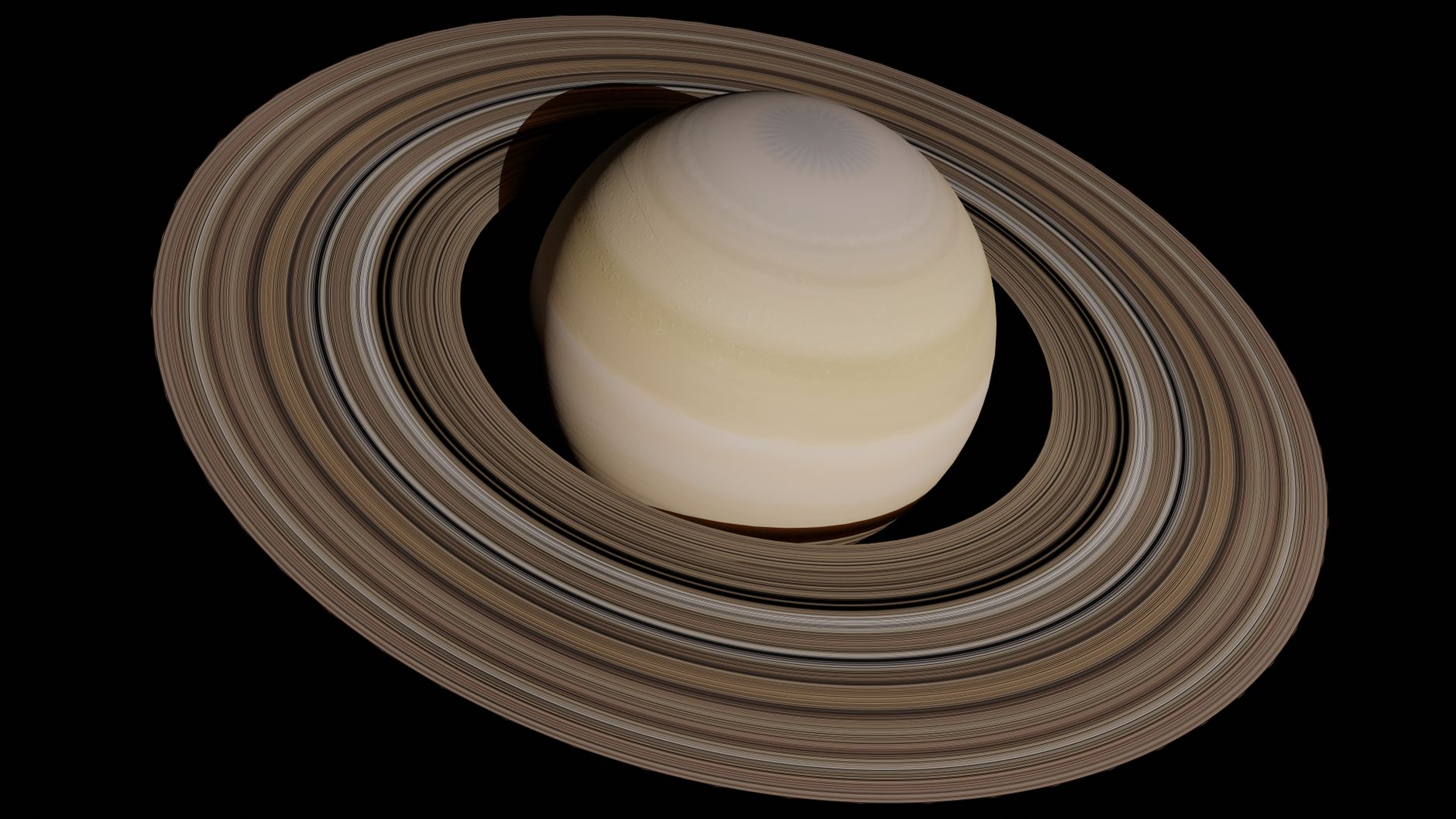
The decagon around Saturn has intrigued scientists as it appears to have emerged recently, showcasing a mysterious new feature at the planet’s south pole.
What is the Decagon Around Saturn?
The decagon around Saturn is a striking and enigmatic feature observed at the planet’s south pole. This ten-sided geometric shape, first detected by the Hubble Space Telescope, has captivated scientists and space enthusiasts alike. Unlike other atmospheric phenomena, the decagon exhibits a stable and persistent structure, which has raised numerous questions regarding its formation and evolution.
Initially spotted in 1988, researchers noted that it had not been present during earlier observations. The decagon is believed to be linked to the planet’s complex atmospheric dynamics, influenced by its rapid rotation and the unique behavior of its winds. This feature spans an impressive 13,000 kilometers (about 8,000 miles) and is surrounded by a vortex, further complicating the understanding of Saturn’s atmospheric patterns.
Scientists propose that the decagon may be a result of a combination of factors, including seasonal changes and varying temperature gradients. As Saturn experiences shifts in its atmosphere due to its long orbital period, the decagon could represent a transient yet stable state within this dynamic environment.
- Location: South pole of Saturn
- Dimensions: Approximately 13,000 kilometers
- Formation: Influenced by atmospheric dynamics
How Was the Decagon Discovered?
The discovery of the decagon around Saturn has captivated astronomers and space enthusiasts alike. This remarkable feature, resembling a ten-sided shape, was first observed by the Hubble Space Telescope in 2019. Researchers were astounded, as the decagon had not been present in images taken just a decade prior.
Utilizing advanced imaging technology, scientists captured a series of detailed photographs of Saturn’s south pole. These images revealed the unique geometry of the decagon, which appears to be a persistent atmospheric phenomenon. The formation is thought to be linked to the planet’s complex weather patterns and jet streams.
Prior observations of Saturn did not indicate the presence of this feature, leading to questions about its sudden emergence. Some scientists theorize that changes in Saturn’s atmosphere, possibly driven by seasonal variations, could explain the decagon’s appearance. Others propose that shifts in wind patterns may play a crucial role in its formation.
As researchers continue to study this enigmatic structure, the decagon around Saturn remains a topic of interest, highlighting the dynamic and ever-evolving nature of planetary atmospheres.
Why Did It Appear Suddenly?
The sudden appearance of the decagon around Saturn has left scientists puzzled and eager to find answers. This intriguing 10-sided feature was first observed by the Hubble Space Telescope and has raised numerous questions regarding its formation and dynamics.
One possible explanation for its emergence is linked to changes in Saturn’s atmospheric conditions. Researchers suggest that shifts in wind patterns and seasonal variations could have contributed to the formation of the decagon. As Saturn completes its long seasons, lasting nearly 30 Earth years, the planet’s climate may evolve significantly, leading to the development of such unprecedented features.
Another theory revolves around the interaction between Saturn’s atmosphere and its internal heat. The planet’s unique atmospheric dynamics, including the influence of its powerful jet streams, may have played a crucial role in creating the stable structure of the decagon around Saturn.
Additionally, some scientists propose that external factors, such as the influence of Saturn’s moons, could have contributed to the formation of this geometric phenomenon. Further studies are needed to determine the precise mechanism behind this captivating atmospheric formation.
What Does This Mean for Saturn?
The discovery of the decagon around Saturn has significant implications for our understanding of the planet’s atmospheric dynamics. This mysterious 10-sided structure, observed swirling around Saturn’s south pole, suggests that the gas giant’s weather patterns are more complex than previously thought.
Researchers believe the decagon may be a result of unique wind patterns and temperature fluctuations within Saturn’s atmosphere. The formation of such geometric shapes could indicate a level of organization in the turbulent storms that dominate its weather system.
Moreover, the sudden appearance of the decagon raises questions about the stability and behavior of Saturn’s atmosphere. Scientists are now looking to explore how long this feature might remain and whether similar patterns could emerge elsewhere on the planet.
Understanding the decagon around Saturn could also provide insights into other gas giants in our solar system and beyond. By studying these atmospheric phenomena, astronomers can refine their models of planetary atmospheres, shedding light on the processes that govern weather systems across different celestial bodies.
In summary, the decagon is not just a curiosity; it represents a vital piece of the puzzle in comprehending Saturn’s complex meteorology.
Comparisons to Other Planetary Features
Researchers have drawn intriguing comparisons between the decagon around Saturn and similar features observed on other planets. One of the most notable examples is the hexagonal storm at Saturn’s north pole, which has garnered significant attention since its discovery. Like the decagon, the hexagon is a persistent atmospheric feature, demonstrating how unique weather patterns can manifest in polygonal shapes due to the planet’s rapid rotation and complex atmospheric dynamics.
Additionally, scientists have noted that Jupiter’s Great Red Spot, while not polygonal, shares similarities in terms of being a long-lasting atmospheric phenomenon. Both the decagon around Saturn and the Great Red Spot highlight the dynamic nature of planetary atmospheres and the forces at play.
On Earth, similar polygonal patterns can be observed in certain large-scale weather systems, though they typically do not last as long as those found on Saturn. This raises questions about the stability and longevity of the decagon and its potential ties to Saturn’s unique atmospheric conditions.
Understanding these comparisons not only provides insight into Saturn’s weather but also enhances our overall knowledge of planetary atmospheres across the solar system.
The Science Behind the Decagon
The decagon around Saturn has captured the attention of scientists and space enthusiasts alike, prompting investigations into its underlying mechanisms. This unique atmospheric feature is characterized by a ten-sided shape, which has puzzled researchers since its discovery.
One of the primary scientific explanations for the formation of the decagon involves the interaction of Saturn’s winds. The planet’s rapid rotation creates a complex system of jet streams that can lead to the emergence of such geometric patterns. The decagon is believed to be a result of these wind patterns colliding, creating a stable structure that maintains its shape over time.
Another factor contributing to the decagon’s existence is Saturn’s atmospheric dynamics. The planet’s thick atmosphere is rich in gases and clouds, which can influence temperature and pressure variations. These variations may play a crucial role in sustaining the decagon, allowing it to persist as a prominent feature in Saturn’s atmosphere.
Additionally, researchers are examining the potential impact of seasonal changes on the formation and stability of the decagon. As Saturn experiences its lengthy seasons, shifts in sunlight and temperature could affect the winds and contribute to the ongoing evolution of this fascinating structure.
Future Observations of Saturn
As scientists continue to study the decagon around Saturn, future observations hold the promise of uncovering more about this fascinating atmospheric feature. The upcoming missions and advanced observational technologies are expected to provide deeper insights into the dynamics of Saturn’s atmosphere and the processes that led to the formation of the decagon.
Future missions may include:
- Enhanced Hubble Space Telescope observations: Continued monitoring of the decagon’s behavior and structure using Hubble could reveal changes over time.
- NASA’s James Webb Space Telescope: This next-generation telescope may capture high-resolution images of the decagon, allowing for a better understanding of its chemical composition.
- Potential new missions to Saturn: Future exploratory missions could involve spacecraft that might gather in-situ data from Saturn’s atmosphere, providing a clearer picture of the decagon’s characteristics.
By utilizing these advanced tools and missions, scientists aim to unravel the mysteries surrounding the decagon around Saturn, including its potential impact on the planet’s overall atmospheric dynamics and climate patterns.
Public Interest in Space Discoveries
The recent discovery of a decagon around Saturn has sparked significant public interest in space discoveries. As more people engage with scientific advancements, the fascination with celestial phenomena continues to grow.
Space enthusiasts and casual observers alike are drawn to the unique patterns and features found in our solar system. The decagon, a ten-sided shape swirling around Saturn’s south pole, has captured the imagination of many due to its mysterious nature and sudden appearance.
Public interest is fueled by various factors:
- Educational Outreach: Increased availability of educational resources allows more individuals to learn about space.
- Media Coverage: Major news outlets and social media platforms share captivating images and findings, making discoveries accessible.
- Community Engagement: Online forums and discussion groups encourage sharing knowledge and excitement about space exploration.
The decagon’s striking shape prompts questions about its formation and implications for our understanding of Saturn. As more discoveries emerge, the public’s curiosity about the universe will only deepen, highlighting the importance of continued research and observation.
Photo by Zelch Csaba on Pexels
Where this came from
Related reading
Air India Flight Suspension: The Right Move During Crisis · Jay Chou Music: Understanding His Digital Legacy and Listening Appeal · Convert PDF to PPT Free – No Cost, No Hassle